Friday, 30 May 2025

Australia just approved Woodside's gas project until 2070. How could it happen? 31st May 2025

 https://www.abc.net.au/news/2025-05-31/woodside-north-west-shelf-approval-did-not-consider-climate/105347716

The Australian government's decision to increase gas mining in WA for the next 45 years did not consider cultural and environmental impact, global warming and climate change.

"Suddenly, a project which is now allowed to go ahead until 2070, it's going to ring alarm bells in a very, very, very big way."


Some weeks more than others, climate change really bears down on Australians.

This week, the news carried images of eerie orange skies as dust storms whipped across landscapes dried from record-breaking droughts. Further north, homes were submerged in floods exacerbated by heavier rain from a warmer climate.

And also this week, the Australian government approved the extension of one of the world's largest gas facilities until 2070.

But this decision isn't about climate change.

At least not under Australia's current laws, where the climate harm from fossil fuel projects doesn't have to be considered.

How can Australia approve a fossil fuel mega-project that will run until 20 years after the world is meant to reach net zero emissions?

"I think the average punter out there is basically saying, 'Hang on, this is about climate change and 2070, what are we doing? What in the hell are we doing?'" lamented Greg Bourne from the Climate Council.

The North West Shelf is already Australia's third-highest emitting facility in the country, producing about 6 million tonnes of greenhouse gas each year.

That's just the direct emissions from extracting and processing the gas and doesn't count emissions after the gas is sold, shipped, and burnt at its final destination.

Some estimates put the total lifetime emissions from this project at the equivalent of a decade of Australia's current emissions.

A decade. Think of it as pushing out Australia's climate goals by another 10 years.

It's not just climate experts warning that the world needs to stop expanding fossil fuels: the International Energy Agency says there is enough existing coal, oil, and gas projects to supply the world and stay the course to net zero.

"The world is awash in gas, primarily coming out from the Middle East, but lots coming out from America and so on like that. I think our Australian companies fool themselves into thinking that they're going to be the last company standing, pushing gas out there,"

"Climate change is one of the most significant challenges facing the global community and one of the greatest threats to Australia's way of life.

"It is time to act. It is time for procrastination to end … We cannot any longer afford to be complacent on this issue."


Woodside's North West Shelf approval just a stepping stone to enable Browse project - 27th May 2025

https://www.abc.net.au/news/2025-05-29/woodside-nw-shelf-approval-to-enable-browse-basin-development-/105344468

When all the hype and the fury is stripped away, the decision to extend the life of the gigantic North West Shelf gas plant boils down to one thing.

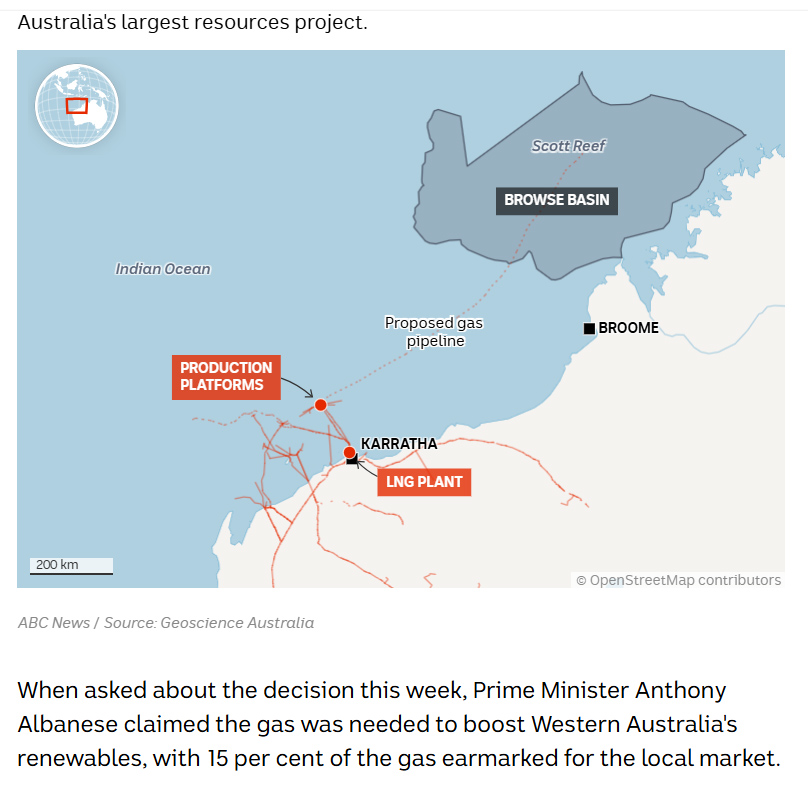
"It's really all about Browse," says RISC Advisory boss Martin Wilkes in relation to the huge gas field off the Kimberley coast of Western Australia.

Browse is one of the country's biggest untapped resources projects, with gas reserves large enough to meet the equivalent of Australia's entire domestic demand for almost 20 years.

To the Western Australian government and the state's industry, it represents energy security, jobs and billions of dollars of investment.

And for some of the world's biggest oil and gas companies — not to mention Australia's flag-bearer, Woodside — Browse presents as the last great hurrah for the country's gas export industry.


Browse is likely to be the mother-of-all environmental fights — a pivotal clash between those seeking an end to new fossil fuel mega-project and those in the opposite corner.

 Climate groups have labelled Browse a "carbon bomb", claiming the project could lead to emissions of up to 1.6 billion tonnes of carbon dioxide equivalent over its lifetime — an amount three times Australia's annual pollution output.


By piping Browse gas 900 kilometres south and processing it through the North West Shelf, he says Woodside would avoid the need for a new LNG plant that would come at huge cost.


Thursday, 15 May 2025

Broome to get big solar farm and six hour battery to replace gas and diesel contract - 16th May 2025

 The remote pearling and tourism town of Broome – in the northwest of Western Australia – is to have its current supply of fossil fuel generation largely replaced by a large solar farm and six-hour big battery, under proposals unveiled by the state-owned Horizon power.
The plans include a 90 megawatt (MW) solar farm, supported by a 42 MW, 239 MWh battery, and associated network infrastructure.
It is designed to replace the current power contract that relies on gas and diesel for the town of 15,000 people, more than 2,000 kms north of Perth. It says the new renewable based system will be cheaper, cleaner, more reliable and offer more economic opportunities.  (source: 
https://reneweconomy.com.au/)


The details of the proposal – first flagged several years ago – are revealed in an application to the state Environmental Protection Agency, and while not the first remote town to feature solar and a big battery, it appears to be one of the biggest of its type in Australia, if not the biggest.

Horizon Power says the Future Energy System (FES) in Broome will ensure security of energy supply to Broome after the expiry of the existing power purchase agreement, and will result in higher renewables and a reduction in one million tonnes of greenhouse gas emissions over the assumed 20-year lifetime of the project.

Wind energy had been considered, but Horizon says it was rejected because the wind resource was not considered strong, and because of the risk of cyclones.

It also cited the remoteness – high maintenance, logistics, supply issues – higher capital cost compared to solar, and environmental impacts to aerial fauna and the challenge of obtaining environmental and regulatory approvals.

The new solar and battery facility will replace the contract with the existing Broome power station, owned by EDL, which includes 17 small gas generators, and nine back-up diesel generators, with a total of 42 MW. There are more than two dozen different generators because of the varying consumer patterns, and the need for back-up.

Horizon says extending the gas and diesel contract would risk high supply costs, reduced reliability (because of fuel supply chain disruptions), and higher emissions, as well as missed economic opportunities in a renewable transition.

The Broome Clean Energy Report, commissioned by Environs Kimberley and produced by Sustainable Energy Now in 2023, estimated that more than 80 per cent of Broome’s electricity generation could be achieved with renewable energy at three quarters of the price of gas-fired generation.

“Many towns in the Kimberley are powered by high emission fossil fuels such as diesel and gas. In Broome, Horizon Power currently purchases power from an independent power producer,” the application says.

“The power purchase agreement (PPA) is due to expire, providing Horizon Power with an opportunity to integrate gridscale renewable electricity into the town supply.”

It says the final design of the project may change before a final investment decision is made.


The proposals includes a 16 kms transmission line, either underground or overhead, that will follow Broome Cape Leveque Road, Broome Highway, Old Broome Road and Fredrick Street to connect the solar PV and BESS to the existing substation on Fredrick Street in Broome.

Friday, 18 October 2024

Gas industry in damage control as landmark study finds LNG 'worse than coal' for the climate 19th Oct 2024


Gas industry in damage control as landmark study finds LNG 'worse than coal' for the climate


In January this year, seemingly out of nowhere, US President Joe Biden made a decision that sent shock waves through the trillion-dollar global gas industry.

With the stroke of a pen, Mr Biden put a pause on approvals for any new project looking to ship super-chilled liquefied natural gas — or LNG — from US shores.

It was a decision that left many in the industry floored.

After all, within just a few short years America had rocketed from a position of having no LNG industry to being one of the world's biggest exporters of the fuel alongside Australia and Qatar.

And it was a decision that has set off a political firestorm in the US, where energy and America's insatiable needs for it are looming, as ever, as a critical issue in an election year.

Underlying that decision, however, was a landmark report that has cast fresh doubt over the supposed environmental benefits of gas compared with coal.

Gas emissions 'worse than coal'

It's a study that has raised fresh questions over the role of gas as a bridge to a renewable energy future.

The peer-reviewed study by Robert Howarth, a professor at Cornell University, found American LNG, at least, was worse than coal when it came to emissions.

Specifically, the report found greenhouse gas emissions from LNG were 33 per cent greater than those related to coal when measured over a 20-year timeline.

And at the heart of Professor Howarth's finding was not carbon but, rather, methane, a far more potent greenhouse gas.


Tuesday, 2 July 2024

When it comes to power, solar could leave nuclear and everything else in the shade


When it comes to power, solar could leave nuclear and everything else in the shade https://www.abc.net.au/news/2024-07-03/energy-power-solar-leave-nuclear-in-the-shade/104049276

Whereas nuclear power is barely growing, and is shrinking as a proportion of global power output, The Economist reported solar power was growing so quickly it was set to become the biggest source of electricity on the planet by the mid-2030s.
By the 2040s — within this next generation — it could be the world's largest source of energy of any kind, overtaking fossil fuels like coal and oil.


Thursday, 21 March 2024

23rd March 2023 - "Can a country run entirely on renewable energy"?


Can a country run entirely on renewable energy?


Businessman Dick Smith has thrown his support behind calls to introduce nuclear-generated power to Australia, rejecting renewable-led electricity generation in the process.

Appearing on Sydney radio station 2GB earlier this week, Mr Smith said Australia "should be making a decision to go nuclear now", pouring cold water on suggestions that wind and solar — and renewables more generally — could instead lead the nation's energy transition.

"Look, I can tell you, this claim by the CSIRO that you can run a whole country on solar and wind is simply a lie," Mr Smith said.

"It is not true. They are telling lies. No country has ever been able to run entirely on renewables — that's impossible."

But experts consulted by RMIT ABC Fact Check suggested Mr Smith's statement doesn't hold up.

Mark Diesendorf, an expert on sustainable energy and energy policy from the University of New South Wales, labelled Mr Smith's assertions as "incorrect".

"Several countries (and Tasmania) already run their electricity systems on 100 per cent renewables," he said in an email, noting that such places relied heavily on hydro power.

Even when focusing on wind and solar-generated power alone, experts rejected Mr Smith's claim that it would be "impossible" for it to power an entire country.

Andrew Blakers, a professor of engineering at the Australian National University's Institute for Climate, Energy and Disaster solutions, told Fact Check: 

"Several detailed studies show that [getting to] 100 per cent renewables based mostly on solar and wind is quite straightforward, provided that enough transmission and storage is built."

Professor Blakers pointed to studies conducted by his research group investigating the feasibility of 100 per cent renewables in a number of countries, including Australia.

"[Solar] and wind [would] allow Australia to reach 100 per cent renewable electricity rapidly at low cost," concluded one such study, co-authored by Professor Blakers and published in 2017.

As for the countries putting renewable power to the test, Mark Z. Jacobson, a professor of civil and environmental engineering at Stanford University in the US, and director of its Atmosphere/Energy Program, pointed Fact Check to a detailed list of countries at or near the 100 per cent renewable energy mark.

"There are four countries running on 100 per cent wind-water-solar (WWS) alone for their grid electricity," he said in an email, noting that a further three countries relied on WWS for 99.78 per cent to 99.99 per cent of their electricity generation, while 45 countries were above 50 per cent.

According to a document produced and supplied by Professor Jacobson, the four countries running on 100 per cent WWS in 2021 were Albania, Bhutan, Nepal and Paraguay.

When it came to regions with a comparable or greater population size to that of Australia, Professor Jacobson pointed to the US state of California, which has a population of around 39 million.

As of Tuesday this week, he said, the state, which is aiming for 100 per cent carbon-free electricity by 2045, had "been running on more than 100 per cent WWS for 10 out of the last 11 days for between 0.25 and 6 hours per day".

While it is not entirely clear what Mr Smith was referring to when he suggested the CSIRO had claimed Australia could run entirely on wind and solar, the national science agency's latest annual GenCost report, released in July 2023, found that wind and solar remained the cheapest form of new-build electricity generation.

An updated draft of the report, released last month after factoring in feedback related to integration costs prior to 2030, also found renewables to be the cheapest form of new-build energy.

The Australian Energy Market Operator (AEMO) has forecast that renewables will be able to meet the entire demand of the national electricity market (NEM) by 2025, albeit for short periods of time (for example, 30 minutes).

Introducing AEMO's 2022 Engineering Roadmap to 100 per cent Renewables, CEO Daniel Westermen wrote that "the power system will require additional engineering solutions to provide essential system services to maintain a stable electrical voltage and frequency and ensure a secure state of operation".

"Proven technologies such as synchronous condensers will play a role, alongside newer technologies such as grid-forming inverters. The human dimensions of this transition are as important as the technical requirements."

In addition, a 2021 report from the Grattan Institute noted that "getting to 100 per cent renewable energy [in Australia] over the next two decades would be expensive unless there are major technological advances to backup renewable supply through rare winter wind droughts".

"That's why Australia should commit only to net zero emissions in the NEM by the 2040s, not absolute zero emissions or 100 per cent renewable energy."

As the institute's James Ha explained at the time, net zero emissions doesn't "require that all electricity people use within the jurisdiction come from renewable sources".

"Some might come from coal or gas-fired generation, but the government offsets this amount by making or buying an equivalent amount of renewable electricity."


FRACKING FACTS

2020 Fracking Facts