Thursday, 12 November 2020

2020 - Nov 13th - Environs Kimberley challenges Twiggy to dump gas investments after FMG's renewable revolt

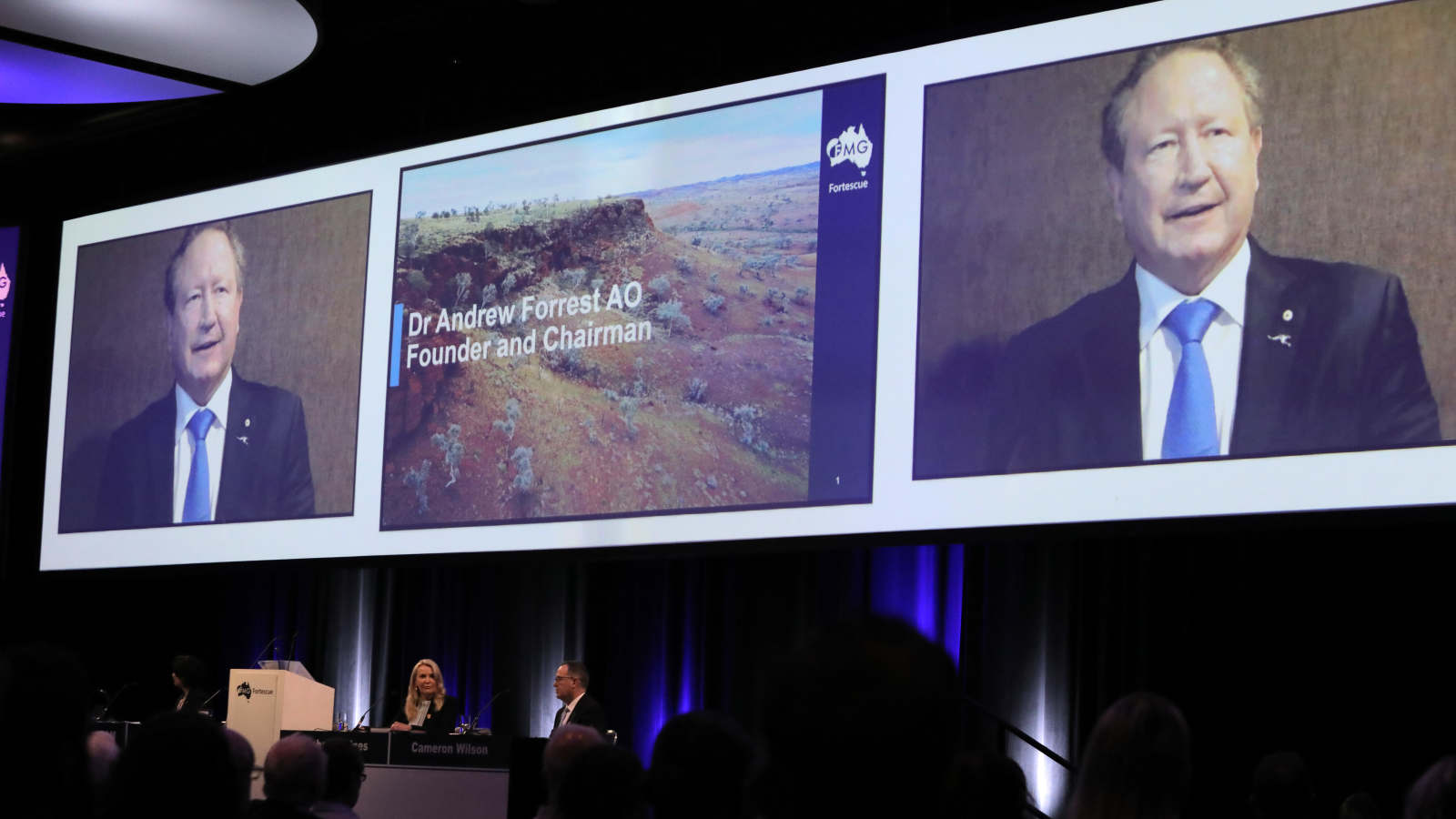
Environs Kimberley has called on mining magnate Andrew Forrest to offload his gas assets after he announced Fortescue Metals Group would embark on a major journey to become one of the world's biggest producers and financiers of renewable energy.

Environs Kimberley director Martin Pritchard welcomed Dr Forrest's announcement at FMG's annual general meeting in Perth on Wednesday, but said his energy business Squadron Energy still had a major focus on fossil fuels in Australia.


"Given Dr Forrest is taking heed of the science of climate change and recognising this is a serious threat to the world, we are calling on him to stop exploring for fossil fuels in the Canning Basin region of the southern Kimberley," Mr Pritchard said.

"Dr Forrest cannot expect to be credible by talking, on the one hand, about renewable energy being the future while still exploring for oil and gas in the Kimberley."


Squadron Energy is owned by Dr Forrest's commercial investment vehicle Tattarang and has renewable energy interests, including a 15 per cent foundation investment in the 4500-kilometre Sun Cable plan to send Australian green electricity to South East Asia.

However, Squadron still has interests in the future Port Kembla gas terminal in NSW and is involved in a gas exploration joint venture with Goshawk Energy across in Kimberley, which Mr Pritchard said did not match with the commitment to tackle climate change.

"There’s an inconsistency in what Dr Forrest’s company Squadron Energy is saying versus what they are doing," he said.

"Dr Forrest is clearly passionate about the marine environment but more oil and gas being burnt is going to lead to more bleaching events on the Great Barrier Reef, Ningaloo Reef, as well as Kimberley coral reefs.

"It’s clear he wants to be a global leader in renewable energy, he’s got the money to do it, but he’s not going to be taken seriously if he’s going to continue to look for new oil and gas deposits."

Dr Forrest wants FMG's green offshoot – Fortescue Future Industries – to produce 235 gigawatts of installed energy capacity annually, which is greater than the equivalent fossil fuel energy produced by Chevron in 2019.

"After scientific and personal analysis of the renewable energy resources of our little planet, I can assure you that there is more than enough renewable energy to sustainably and economically supply every person on this planet from this time forth," he told shareholders on Wednesday.

"When we as Fortescue, the pioneer, can really lead the way of large volume, low-cost, green hydrogen and green ammonia shipped around the world, then you'll see others join and you will begin to see the commercial driving end of climate change."

Dr Forrest is currently travelling overseas and a spokesman said he was unable to be reached but Squadron Energy chief executive Stuart Johnston said the business supported initiatives that would lead to a lower carbon economy such as the Sun Cable but believed natural gas had an important role to play in that transition.

"Our commitment to bringing the Port Kembla gas terminal online by 2022 can play a critical role in reinforcing grid reliability today while supporting further investment in carbon-free technologies that can more rapidly decarbonise the economy," he said.

"Our future plans for the project include the development of a dual fuel - LNG - hydrogen 800MW power station in the Illawarra that can be initially fuelled by gas from the gas terminal with a flexible design that provides for large scale dispatchable power and the ability to transition to hydrogen fuel as hydrogen suppliers bring industry scale production online."


2020 - Nov 13th - Victoria plugs in record number of renewable energy generators

 https://www.theage.com.au/environment/climate-change/victoria-plugs-in-record-number-of-renewable-energy-generators-20201112-p56dyj.html

Record numbers of large-scale renewable energy generators have been connected to the grid in Victoria over the past year, eclipsing every other state in the national energy market.

But widespread bushfires, extreme weather and record-low demand for power have all combined to place considerable pressure on Victoria's energy transmission network in 2019-20, according to the annual outlook report from the Australian Energy Market Operator.

The Coonooer Bridge wind farm in Victoria. 

"We are seeing record levels of investment in new large-scale renewable energy generation, with AEMO having connected more generators in Victoria over the period than in any other NEM [national electricity market] state," AEMO chief executive Audrey Zibelman said.

Victoria now has about 7.8 gigawatts of existing, or committed, wind and solar generation, and 2.9 GW of this comes from rooftop solar.


Since last year's snapshot, which assessed the capacity and adequacy of the state's transmission network to meet its energy demands, there has been a 1.6 GW increase in Victorian large-scale wind and solar projects, with a record 16 projects connected or commenced.

"While under typical operating conditions Victoria’s transmission network is secure, strong investment in renewable energy has impacted the stability of power system operations, including record minimum demand levels," the AEMO report says.

South Australia experienced record minimum demand last summer, with the increased number of rooftop solar systems leading to new, all-time low demand for grid-based power during the hottest part of the day.

The influx of renewable energy - especially rooftop solar panels - has raised problems for the power grid. This increasing gap between minimum and maximum demand puts pressure on older gas and coal units that do not have the flexibility to turn off during the day when demand is low and return for the evening peak.

Energy market analyst Paul McArdle, managing director of Global-Roam, said that when the AEMO describes the operational landscape in Victoria as "increasingly complex," it meant the level of risk in the national electricity market was increasing.

"This doesn't mean, automatically, that the lights are going to go out – but it does mean that it's becoming increasingly challenging to manage that risk."

Earlier this month, Victorian Environment Minister Lily D'Ambrosio announced one of the world's largest lithium-ion batteries will be built near Geelong to bolster the reliability of the grid and keep a lid on power prices as coal-fired generators retire.

The battery will help to reduce the strain on the grid during peak periods, especially in summer.

Ms Zibelman said AEMO would spend $3.5 billion over the next decade to maintain supply reliability and system security, including on the the Victoria to NSW interconnector – which will boost power flows between the two states – and the expansion of renewable energy zone projects that co-ordinate the development of new grid infrastructure in energy-rich areas.

NSW last week announced $32 billion in private investment to support, among other things, 12 GW of new renewable energy capacity by 2030 in three regional areas.

Victoria's Loy Yang A power station to have 200MW battery operational by 2023, owner AGL says

The Loy Yang A power station in Victoria's Latrobe Valley will be home to a new 200 megawatt (MW) battery that can provide electricity to the grid during times of peak demand, its owner has said.

Energy giant AGL plans to start construction mid to late next year and have the battery operational in 2023.

It will form part of an 850MW battery system the company is developing across four sites, including a 250MW battery at the Torrens Island power station in South Australia.

AGL general manager major projects Lucy Martin said batteries were an important part of Australia's shift towards renewable power.

"With solar and with wind, when the wind's not blowing or the sun's not shining, like on a day like today, then we need to have that capacity to be able to buffer the supply," Ms Martin said.

She said the battery would also support the grid during times of peak demand during summer or when Loy Yang A capacity was reduced during maintenance.

2020 - Nov 13th - BOM and CSIRO State of the Climate shows Australia is experiencing climate change now

 https://www.abc.net.au/news/2020-11-13/bom-and-csiro-state-of-the-climate-2020/12871690


The Bureau of Meteorology and the CSIRO have teamed up for the latest biannual report on the climate, and the findings are clear: Australia is experiencing climate change now, and the warming trend is continuing.

We are now up to 1.44 degrees Celsius of warming since 1910, plus or minus 0.24C, resulting in increased extreme heat days, heatwaves and raised fire danger.

Karl Braganza, manager of the climate environmental prediction service at the Bureau, said the science had been broadly consistent and largely accurate in the way that it had portrayed and projected the climate system for the last several decades.

"What we are seeing now is a more tangible shift in the extremes, so we are starting to feel how that shift in the average is impacting on the extreme events," he said.


"We don't necessarily feel the 1.44 degree increase in Australia's average temperature but we feel those heatwaves and we feel that fire weather."

In the two years since the last State of the Climate report we have lived through 2019, the hottest year on record, which produced one of the worst fire seasons we have ever seen.

Dr Jaci Brown, research director at the CSIRO's climate science centre, says that in 10 to 20 years' time, 2019 will not be seen as unusual.

"In fact, we think of this decade being hot, but this decade will be one of the coolest in the next hundred years," according to Dr Brown.

Fire threat

This time last year swathes of the east coast were already on fire and Sydney had just faced down catastrophic fire danger.

It fits the trend of the fire season starting earlier and hitting with increasing intensity.

"Absolutely we are saying that Australia should prepare for an increased fire risk," Dr Braganza said.


He said the sort of fire events seen since the 2003 fires in Canberra were not one-offs.

"They are the sort of events we should treat as becoming more and more likely as warming continues."

Dr Brown was emphatic: "The message is very clear here. The State of the Climate report shows warming, it shows conditions drying through parts of Australia, and the projections are for hotter and dryer conditions going forward."

Changes in rainfall

Many parts of the country have seen a welcome change, with wetter conditions in recent months, but that does not mean we are out of the woods long-term.

Southern cool season rainfall is expected to continue to decline.


Three quarters of hydrologic reference stations across the country show a declining trend in streamflow.

According to Dr Brown, a lot of climate change is locked in, and so adaptation is a big part of what we do from now.

"Australian farmers, for example, are very used to dealing with climate variability and coming up with clever ways to manage and adapt," she said.

"New types of crops, new things to plant, new ways to work together to keep ourselves strong through these next few decades."

In contrast, northern warm season monsoonal rainfall has been above average over the last two decades.

But this rainfall remains inconsistent. Both the last two wet seasons recorded below-average rainfall.


As the atmosphere and oceans continue to warm, heavy rainfall is expected to become more intense.

Ocean sinks

As we have pumped CO2 into the atmosphere the oceans have acted as a sink for both CO2 and heat.

But that has not come without an impact upon our oceans.

Surface waters around Australia are estimated to have had a 30 per cent increase in acidity since the 1880s, and sea levels have risen by 25cm globally since 1880 as a result of thermal expansion and ice melt.


The rate of sea level rise is increasing. It is now up to an average of 3cm per decade globally, but this is dependent on location.

Australia's northern and south-eastern coasts have been well above the global average, with the north-eastern and southern coastlines closer to average.

Although the total number of tropical cyclones is expected to decrease in the future, warmer oceans, higher sea levels and more intense rainfall all increase the risk posed by tropical cyclones in the future.

2020 slowdown not enough to stem the tide

Even 2020's global slowdown hasn't been enough to stop atmospheric concentrations of CO2 from increasing.

Dr Brown said there was a drop in the rate of increase of CO2, but that the slowdown was indistinguishable from the background variability.

"Another way to think about this is, if you have been eating junk food for 10 years and then you go on a diet for one day and you jump on the scales the next morning expecting to see some change, drop a dress size.

"It is not that simple. This is about a very long-term change"


CO2 concentrations in our atmosphere are now well above any level reached in the last 800,000 years.

"I think the big challenge for our children and our grandchildren will be how to flatten this curve," Dr Brown said.

This year

Australia is currently under the influence of the La Niña phase of the El Niño Southern Oscillation.

La Niña events are typically associated with wetter-than-average conditions for all but the south-west.

Currently this year's La Niña is not tracking to be as severe as the last major La Niña in 2010/2011, but the Bureau will continue to monitor how the oceans warm over spring.


YOUTUBEBOM Severe weather outlook

There is an increased risk of flooding for the east and north, with an above average risk of cyclones this summer.

Wednesday, 11 November 2020

2020 - Nov 12th - WHAT IS A GIGAWATT and a MEGAWATT?


1 billion watts = 1 gigawatt

Gigawatts measure the capacity of large power plants or of many plants. One gigawatt (GW) = 1,000 megawatts = 1 billion watts.
How many houses can 1 gigawatt power?
One megawatt can meet the instantaneous demand of at least 750 homes, so in these instances, solar was powering more than 750,000 California homes. (1 GIGAWATT)
1 megawatt = 1 million watts

Andrew Forrest’s iron ore mining giant Fortescue Metals has unveiled stunning plans to build more than 235 gigawatts (GW) of renewable capacity, mostly wind and solar  
Victoria will be home to the largest battery in the southern hemisphere as part of a State Government push to transition to renewable energy.

Renewable energy company Neoen will pay for the 300 megawatt Tesla battery to be installed at Moorabool, near Geelong. (equivalent of powering 225,000 homes)

The new battery will be twice the size of the battery at the Hornsdale Power Reserve in South Australia.

280MW Cultana solar farm will be the biggest in South Australia,

2020 - Nov 12th - Fortescue leads “stampede” into green energy with stunning plans for 235 gigawatts of wind and solar


Andrew Forrest’s iron ore mining giant Fortescue Metals has unveiled stunning plans to build more than 235 gigawatts (GW) of renewable capacity, mostly wind and solar, to become a supplier of green energy and hydrogen that would rival the country’s biggest oil suppliers in terms of energy produced.   (equivalent of powering 176,000 homes)

The extraordinary vision – and the creation of Fortescue Future Industries – was unveiled by Forrest at the company’s annual general meeting on Wednesday, and it represents the single most aggressive push into renewables ever unveiled.

“It is a time that has come. After scientific and personal analysis of the renewable energy resources of our little planet I can assure you that there is more than enough renewable energy to sustainably and economically supply every person on this planet from this time forth,” Forrest told shareholders in an address to the AGM.

“It is our job to respectfully use these readily available renewable resources and supply the world’s fuel and power at sufficient scale to satisfy the need for abundant, cheap, zero pollutant energy.”

The scale of the program is breathtaking. To put it into context, 235GW of wind and solar is equivalent to nearly five times the current capacity of Australia’s main grit, more than 20 times the size of the proposed Sun Cable solar project Forrest is developing in conjunction with software billionaire Mike Cannon-Brookes, and more than the energy output of oil giants such as Chevron and Total.

Forrest did not outline specifics about where and when the scale of projects would be built, but said nearly 50 countries had and would be studied for their potential and government interest.

And he made it clear it would focus on products such as green hydrogen and ammonia, which would not just satisfy domestic energy and manufacturing needs, but also international markets in fuels, fertilisers and in green metals.

A “flywheel” plan illustrated in the presentation to shareholders indicates a focus initially on hydrogen and building the first 100GW of wind and solar, and then using the cash flows and lower costs from that investment to further expand the amount of renewables and green hydrogen.

Forrest said renewables and renewable hydrogen could be applied to fuel cells, ammonia, steel making, and industry heating. “Fortescue is building a major Renewable Energy/Green Industry business with global scale,” Forrest said, referring to the coming “stampede” into renewable energy and green industries.

Fortescue Future Industries has a team of about 40 executives working on the plan, and Forrest revealed that the team had visited 23 countries, and would visit 24 more, to assess their government.

Fortescue has been focusing first on the transition of its own energy consumption, including for its big iron ore projects in the Pilbara. The first 60MW solar farm at Chichester is nearly complete, and will be followed by another 150MW solar farm and a big battery at its other iron ore projects.

It is also moving into green hydrogen in its iron ore operations, and connect the solar production to Australia’s largest electroylser in mid-2021 to generate green hydrogen for its hydrogen fuel cell bus fleet trial at Christmas Creek operations, and then moving to trucks, trains and ships. The plan to reach zero net emissions for its own operations by 2040, or before.

“This revolution has to begin at home, it has to begin at Fortescue,” Forrest said. The company would then move to a multi-gigawatt renewable hydrogen project to replace one billion litres of imported fuel.

He said the company had been working for the past five years to collect licences and patents to put the technology plan together, and had now engaged more than 25 governments around the world.

“This will place us up there with the  major energy companies in the world if we fully develop them,” he said. “As each project tolls in we will consider them on their merits … and we will go ahead and finance those projects.

“Those first targets of 235GW of green energy … will be financed conservatively and away from our balance sheet. I see, once we can create sufficient renewable fuels, and we can guarantee reliability of supply at scale, there will be a veritable stampede into green energy and green industry.”


Tuesday, 10 November 2020

2020 - Nov 11th - Pipeline giant Jemena plan to open Beetaloo gas reserves in NT for east coast users

 Pipeline giant Jemena has revealed a $6bn plan to open up the Northern Territory’s vast Beetaloo gas reserves for east coast users and Darwin LNG exports, as a major producers group warned the industry faced an attack from professional activists shifting their focus to gas from coal mining.

Jemena, owned by China State Grid and Singapore Power, has proposed a staged investment scheme that could eventually boost the capacity of its Northern Gas Pipeline ten-fold.

Jemena will consider partnering with infrastructure players and superannuation firms to fund the projects along with potential assistance from the Morrison government’s Northern Australia Infrastructure Facility.

It’s aiming to fill the pipeline with production from the prospective Beetaloo, a huge gas basin prioritised by the Morrison government for fast development and widely seen as the next big source of gas for Australia’s east coast.

A partnership deal has been signed between Jemena and Tamboran Resources, a junior partner with Santos in Beetaloo and McArthur acreage 600km south of Darwin, with Jemena hoping to open talks with other major producers including Origin Energy ahead of potential production from Beetaloo in 2025.

The Jemena scheme would initially focus on a $1bn plan to double capacity of the Northern Gas Pipeline — which links Tennant Creek in the NT to Queensland’s Mount Isa — by 2025, and a separate $1bn investment to connect the inland Galilee gas reserves to the Wallumbilla hub, which has also been name-checked by the government as a priority area for development.


Pipeline giant Jemena plans to open Beetaloo gas reserves for east coast users.


The biggest investment of about $3bn would loop and expand the Northern Gas Pipeline to the Galilee Pipeline with capacity of up to 1000 terajoules a day. The final part of the jigsaw would see $1bn invested in connecting the Beetaloo to Darwin, where both the Darwin and Ichthys LNG export plants already operate.

“This is an important step towards delivering on the Commonwealth government’s plans for the Beetaloo as part of a gas-led recovery from the COVID-19 pandemic,” Jemena managing director Frank Tudor said.

While the Morrison government has swung behind the gas sector with a raft of initiatives to boost its role in the economy, the major producers group Appea has warned the industry needs to be on the front foot against activist investors.

“With a gas-fired recovery we have a pivotal moment to support Australia back to growth. However, we are challenged by a vocal minority that would prevent responsible development of Australia’s reserves, preferring instead to turn the community and political decision makers against the industry and its role,” Andrew McConville, chief executive of the Australian Petroleum Production and Exploration Association which represents the energy industry, will tell the Seaaoc conference in Darwin on Wednesday.

“Professional activists have set their sights on the gas sector, not unlike the coal industry before us. They seek to delegitimise our members’ activities and divert investment away from the sector.”

Activist campaigns “are yet to make a major impact on community sentiment towards oil and gas. But the risk for our members is that the noise will get louder and government and investors may increasingly take their cues from these groups,” Mr McConville will say.

Meanwhile, Santos cheered the jump in oil prices on Monday along with the potential vaccine breakthrough, but cautioned new investment in the energy sector would still hinge on a sustained lift in crude coupled with government stimulus to ensure the industry can meet new demand.

Shares in the Australian producer jumped 12 per cent during Tuesday trading after oil prices surged 8 per cent overnight Monday, their biggest daily gain in five months.

“Certainly the positive vaccine news is welcome as are higher oil prices overnight,” Santos chief executive Kevin Gallagher said.

“But as always I’m focused on the things we can control – reducing our cost of supply and sticking to our disciplined, low cost operating model so that Santos is resilient throughout the commodity price cycle.”

The industry‘s other big names also benefited with Oil Search up 17 per cent, Woodside Petroleum rising 7 per cent, Origin Energy lifting 8 per cent and Beach Energy up 15 per cent.

Oil fell during Tuesday trading as concerns over crude demand in big consuming countries outweighed the initial COVID-19 vaccine-led rally.

Oil has more than doubled from lows of less than $US20 a barrel during the onset of the pandemic earlier this year but at $US39 a barrel remains at levels where many producers would be reluctant to sign off on big capital investments.


“It will take a period of sustained improvement in oil prices and government stimulus to incentivise the capital investment required to grow supply to meet future demand and of course provide the secure, skilled, well-paying jobs that are going to be needed as our society recovers from the economic downturn caused by the pandemic,” Mr Gallagher said.

Monday, 9 November 2020

2020 - Nov 10th - Gas-led recovery likely to be a 'mirage' and lead to 'stranded assets'

 The Federal Government's planned gas-led recovery could turn out to be a mirage, according to energy experts who question the economic case for investing in gas infrastructure when fossil fuels are being rapidly replaced by renewable energy sources.

In September, Prime Minister Scott Morrison announced a plan to "reset the east coast gas market" by "unlocking gas supply" and "delivering an efficient pipeline and transportation market" to drive the nation's economic recovery.

Mr Morrison also issued a warning to electricity companies.

"To ensure affordable, reliable power, we need the market to deliver 1000 megawatts of new dispatchable capacity," he said.

"If not, my Government will step up and we will fill the gap."

The Prime Minister said the government-owned Snowy Hydro company would build a gas generator in the Hunter Valley if the electricity sector failed to meet the energy shortfall left by the scheduled closure of the coal-fired Liddell power plant in New South Wales.

Yet the energy market operator has revealed that several planned projects in the state would exceed the interim reliability shortfall.

"Let's be clear," Minister for Energy and Emissions Reduction Angus Taylor told 7.30.

"The market operator said there's a reliability gap of substantially more than that when you go out a few extra years.

"But we're also focused on affordability, not just reliability.

"We're losing up to 1,600 megawatts of capacity when Liddell closes.

Tony Wood, energy director at the Grattan Institute, told 7.30 that promoting a gas-led recovery was "quite an extraordinary step and almost certainly unnecessary".

"The wish that gas prices would one day be as cheap as they used to be, is almost certainly doomed," Mr Wood said.

"Building long-term gas infrastructure, it almost certainly will be a stranded asset at some point in the future.

"A gas-led recovery is likely to turn out to be a mirage, to be honest."

A 'reckless' and 'dangerous' course of action

Jillian Broadbent, former chair of the Clean Energy Finance Corporation, described the Government's planned intervention as "reckless" and "a dangerous decision".

Ms Broadbent said she too was concerned that gas infrastructure such as pipelines and gas hubs could become stranded assets.

The Australian Petroleum Production and Exploration Association (APPEA), which represents Australia's oil and gas producers, told 7.30 its members were well-placed to drive the economic recovery.

"In the last decade, our industry invested $350 billion in Australia in projects for both domestic supply and export to our trading partners in Asia," it said.

"Supporting a gas-led recovery doesn't mean we're looking for direct financial support from the Government or that we're asking for other energy sources to be excluded from the mix."

Ultimately, the states and territories might undermine the Federal Government's gas plan with their own renewable energy plans.

NSW Energy and Environment Minister Matt Kean described gas as "actually a very expensive way of generating electricity".

"My focus is on ensuring the families and businesses of this state get access to the cheapest forms of reliable energy," Mr Kean said.

"We're taking a technology-neutral approach to that, and in doing so we know that the cheapest forms of reliable energy are wind, solar, pumped hydro and batteries."

Where our electricity comes from now, and tomorrow

The National Energy Market generates almost 200 terawatt hours (TWh) of energy each year to power households and businesses.

Coal still accounts for 68 per cent of the energy mix, but is on the decline, with 10 coal-fired power stations having closed since 2012.

Seven of the remaining 16 coal-fired stations in the national energy market are expected to close over the next 20 years.

Renewables, such as wind, hydro, grid-scale and rooftop solar and batteries, currently account for almost 24 per cent of our energy generation annually.

Gas currently accounts for 8 per cent.

The forecast for gas, according to the energy market operator, is to play a supporting though declining role as Australia transitions to new renewable energy sources.

While residential and commercial gas consumption has risen, total domestic consumption in eastern Australia has declined 21 per cent since 2014, when gas exports took off, and the domestic gas price rose.

"That record level of investment we've seen in solar and wind in recent years, is all about bringing down our emissions. But we need to have those complementary dispatchable energy sources."

Santos set to drill wells in Narrabri

Despite 23,000 submissions, the majority of them objecting to the project, Australia's largest domestic gas supplier Santos has received NSW Independent Planning Commission (IPC) approval to drill up to 850 gas wells in northern NSW.

Mr Taylor said the Narrabri gas development was one of many different projects across the country that were needed to deliver more affordable gas.

"We need that supply," he said.

Santos chief executive Kevin Gallagher said the project would access an "abundant energy source" to increase manufacturing and industrial capacity, and that "no gas project could lead to higher gas prices".

One of the benefits of the Narrabri gas project in particular, is that it will bring gas closer to those New South Wales markets. The suppliers, the sort of buyers, [are] the manufacturers, the industrial users," Mr Gallagher said.

However, local landholder and one-time Greens candidate Peter Willis has concerns about the approval process.

"I don't believe Santos or the IPC would have had enough time to go through all the tens of thousands of submissions, with proper due diligence," he said.

Mr Gallagher disagreed and noted "the vast majority" of submissions were "form submissions by the same sort of core people submitting them".

A proposed high-pressure underground pipeline connecting the Narrabri gas field to the Hunter Valley has NSW Government approval to cross Mr Willis's land near Quirindi.

A pipeline to nowhere?

The pipeline's proponent, Garbis Simonian from Hunter Gas Pipeline, must now negotiate access for a maintenance easement with up to 500 landholders.

Farmers like Mr Willis have objected to giving workmen access to their properties.

"We hope our initial refusal of access to our paddocks is sufficient for them not to be able to prove to the Government they can gain the easements in the first instance," he said.

The pipeline will run right through the Hunter electorate of Labor MP Joel Fitzgibbon.

Mr Fitzgibbon said he supported the pipeline because it would provide "economic opportunity for my people".

"My interest is in the reliable and affordable gas it provides and the jobs that will flow from that," he said.

But retirees Susan and Roland Johnson, who knew the pipeline had approval to cross their land when they bought their property at Stanhope in the Hunter Valley, are worried the pipeline will become a white elephant.

The pipeline's expected route was changed and is now closer to their home.

"Why spend billions of dollars on what will become a stranded asset?" Mrs Johnson asked.


FRACKING FACTS

2020 Fracking Facts